ContactPost: CIVIL AVIATION AUTHORITY OF MALAYSIA Tel: 6-03-8778 4106 Email: ais@caam.gov.my URL: aip.caam.gov.my | AIP Supplement for Malaysia | AIRAC AIP SUP 41/25 Effective Date: 04 SEP 2025 Publication Date: 24 JUL 2025 |
ContactPost: CIVIL AVIATION AUTHORITY OF MALAYSIA Tel: 6-03-8778 4106 Email: ais@caam.gov.my URL: aip.caam.gov.my | AIP Supplement for Malaysia | AIRAC AIP SUP 41/25 Effective Date: 04 SEP 2025 Publication Date: 24 JUL 2025 |
1.1 Flow management is used to regulate traffic for:
Arrivals into KL International Airport / Sepang;
Arrivals into Subang Airport /Sultan Abdul Aziz Shah; and
Aircraft transiting into Kuala Lumpur FIR and departures from airports within Peninsular Malaysia flight planned over the Bay of Bengal.
1.2.1 A flow management unit is established at the Kuala Lumpur Air Traffic Control Centre. The unit is responsible for planning the traffic flow to achieve optimum use of the available airspace and runway capacity at the airport(s). Generally, arriving aircraft are sequenced in landing order and any significant delay absorbed before the aircraft enter TMA airspace.
1.2.2 Flow control sequencing action may include:
Speed control. This may require aircraft to maintain a speed as high as possible or reduce speed, consistent with aircraft performance profiles;
Radar vectoring. This may involve track shortening or lengthening through radar vectoring by ATC;
Holding. Aircraft may expect to be held at an outer holding pattern when necessary.
1.2.3 Pilots of aircraft subject to holding action by ATC, will be provided with a time to leave the holding pattern.
1.2.4 When runway or airspace congestion is expected or occurs, traffic may be regulated by the imposition of slot times for departures and/or arrivals. Slot times are only applied to aircraft departing from airports within the Kuala Lumpur FIR for either Subang Airport / Sultan Abdul Aziz Shah or for KL International Airport / Sepang.
1.2.5 When slot times are to be applied, pilots will be informed by ATC at the departure aerodrome, prior to start up clearance, that traffic delays can be expected at Subang Airport / Sultan Abdul Aziz Shah or KL International Airport / Sepang and will be offered a slot time for departure.
1.2.6 The slot time will be based on a flow management planned Expected Landing Time (ELT) for Subang Airport / Sultan Abdul Aziz Shah or KL International Airport, as applicable.
1.2.7 When a slot time is provided, it is a joint pilot/ATC responsibility to ensure that the aircraft is able to depart within (a parameter) minutes of the slot time in order to make good the ELT at Subang Airport / Sultan Abdul Aziz Shah or KL International Airport / Sepang.
1.2.8 Once a slot time has been applied, under normal circumstances there should be no holding; however, there may be a need for limited application of speed control.
1.3.1 Speed control is used to reduce the need for radar vectoring in the establishment of an approach sequence.
1.3.2 ATC may instruct aircraft to adjust their speed in accordance with the table in ENR 1.6. All speeds are minimum IAS.
1.3.3 Above FL 240 speed control will be based on Ground Speed or Mach No.
1.3.4 A pilot will be advised to resume desired speed when a specific speed control instructions is no longer necessary.
1.3.5 Unless otherwise stated, a speed control instruction applies until the aircraft reaches the point in the descent profile where the speed would normally be reduced below that assigned by ATC.
1.3.6 Unless otherwise specified, a clearance for final approach or a clearance for a visual approach terminates speed control.
1.3.7 Pilots may request an alternative sequencing action when the speed control instruction is unacceptable on operational grounds.
1 Note: For flights destined for KL International / Sepang, please refer to AD 2-WMKK-1-28 para 2.22.5.6.
1.4.1 The following phrases may be used to issue speed restrictions for flow control purposes.
Descend at ……................. Knots
Cruise and descend at....... Knots
Cruise at ……….Mach Number/Ground Speed
Reduce speed to/by........... Knots
Increase speed to/by.......... Knots
Maintain……….................... Knots [as long as possible]
[until……..miles finals]
[for the next……..miles]
Resume normal speed
If acceptable, reduce speed to/by…………Knots/Mach Number, advise
Cross (significant point) at (time) [at (speed)]
2.1.1 The States of the ICAO Asia/Pacific Region, which have westbound nighttime flights operating through the Kabul FIR between 2000 UTC to 2359 UTC, are re-activating the integrated Air Traffic Flow Management (ATFM) service using the Bay of Bengal Cooperative ATFM System (BOBCAT).
2.1.2 The Kabul FIR Contingency Coordination Team teleconference (23 April 2025) along with the BOBCAT Resumption Side Meeting during the Fifteenth Meeting of the Asia/Pacific Air Traffic Flow Management Steering Group (ATFM/SG/15, Bangkok, Thailand, from 28 April to 02 May 2025) agreed to the resumption of the BOBCAT ATFM procedures to support the ongoing Afghanistan contingency arrangement, to alleviate operational and environmental impact while en-route ATC service remained absent.
2.2.1 As one of the ATFM services provided, Bangkok ATFMU provides ATFM service for westbound flights intending to transit Kabul FIR between 2000 UTC and 2359 UTC daily. The service provided includes calculation, promulgation, and management of mandatory Calculated Take-Off Time (CTOT) and flight level, ATS route, and Calculated Time-Over (CTO) at entry waypoint for entry into Kabul FIR for each affected flight.
2.2.2 Air Navigation Service Providers (ANSPs) retain responsibility for the tactical management of flights that are subjected to this ATFM measure. In discharging tactical responsibilities, ANSPs will manage non-ATFM compliant flights using delayed pushback and start clearances, non-preferred routes and/or flight levels, enroute holding and/or diversion around Kabul FIR.
2.2.3 Bangkok ATFMU utilizes the automated, web-based BOBCAT in providing ATFM service in the Kabul FIR. These responsibilities will be managed in coordination with airspace users and ANSPs concerned.
2.2.4 This section describes in greater detail the procedures involved in the BOBCAT ATFM service. The objectives of this service are to:
Reduce ground and enroute delays;
Maximize capacity and optimize air traffic flow through Kabul FIR;
Provide an informed choice of routing and flight level selection;
Alleviate unplanned in-flight re-routing and technical stops; and
Assist regional ANSPs in planning for and managing workload in handling increased air traffic flow through Kabul FIR.
2.3.1 All westbound flights intending to enter the Kabul FIR between 2000 UTC and 2359 UTC daily on ATS routes and flight level in Table 1 shall comply with the BOBCAT ATFM procedures contained herein. This includes a mandatory requirement for all flights to obtain a specific ATFM slot allocation – CTOT, CTO at Kabul FIR entry way point, allocated flight level, and allocated ATS route – from the Bangkok ATFMU for entry into Kabul FIR during the period above mentioned.
Table 1: ATS Route and Flight Levels Requiring ATFM Slot Allocation
| Routing through the Kabul FIR | Metering Waypoint(s) | Flight Levels |
|---|---|---|
| M875 – TAPIS – L509 | LAJAK | FL320, FL340, FL360, FL380, FL400 |
| N644 | DOBAT | FL360, FL380, FL400 |
| L750 | BIROS | FL360, FL380, FL400 |
| P628 | ASLUM | FL360, FL380, FL400 |
| UL333 | SERKA | FL360, FL380, FL400 |
2.3.2 Flights that plan to enter Kabul FIR without an ATFM slot allocation – CTOT, CTO at Kabul FIR entry waypoint, allocated flight level, and allocated ATS route – will be accommodated only after flights with slots have been processed. Such flights should expect delayed push back and start clearances, non-preferred routes and/or flight levels, en-route holding and/or diversion around Kabul FIR.
2.4.1 The following flights are exempted from BOBCAT ATFM procedures:
flights experiencing an emergency, including aircraft subject to unlawful interference;
flights on search and rescue (SAR) or rescue and firefighting (RFF) missions;
urgent medical evacuation flights specifically declared by medical authorities where flight delays would put the life of patients at risk;
flights with “Head of State” status; or,
other flights specifically identified by State authorities.
Note: After medical flights have completed their mission; they should be subject to ATFM measures. Scheduled patient transfer flights are, by nature, non-urgent and should not be given priority under normal operational situation.
2.4.2 Airspace users uncertain whether their flights should be exempted should contact Bangkok ATFMU for clarification.
2.5.1 Affected flights shall obtain the mandatory Kabul FIR slot allocation – CTOT, CTO at Kabul FIR entry waypoint, and allocated flight level and ATS route from the BOBCAT system. The Kabul FIR slot allocation will enable ANSPs to tactically control westbound flights transiting the Kabul FIR at specified times by assigning minimum spacing requirements at specified FIR boundary waypoints of the Kabul FIR.
2.5.2 The application, calculation, and distribution of CTOT and associated Kabul FIR entry waypoint slot allocations will be managed via internet access to the BOBCAT system in accordance with the BOBCAT ATFM operating procedures in section 2.6.
2.6.1 All affected flights are required to submit slot requests to the BOBCAT system by logging into https://www.bobcat.aero between 0000 UTC and 1159 UTC on the day of flight and completing the electronic templates provided.
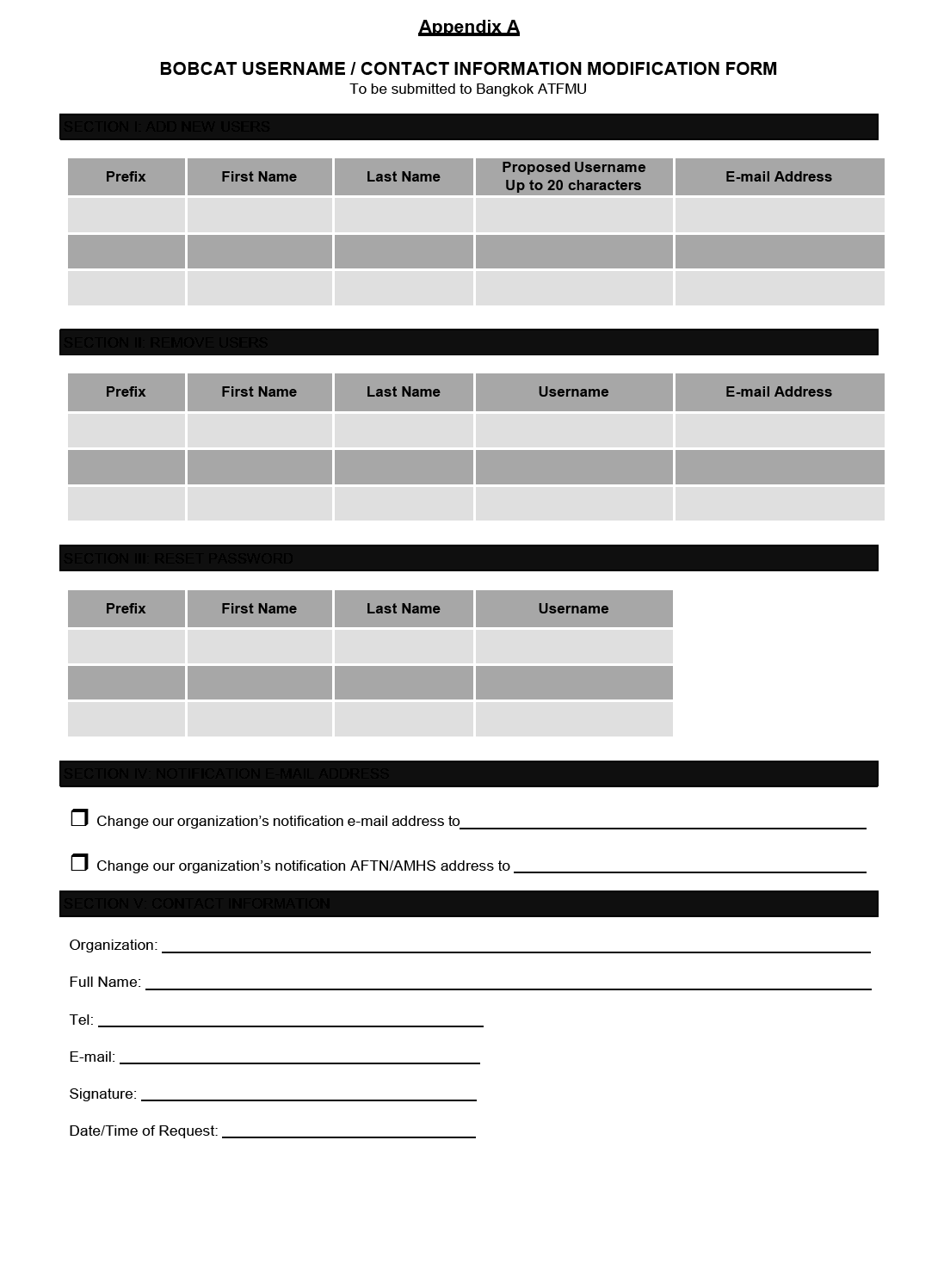
2.6.2 Affected operators who do not have dedicated BOBCAT username/password access should complete the attached application form in Appendix A and email the form to the Bangkok ATFMU as soon as possible.
2.6.3 Slot Allocation Process
The slot allocation is divided into 3 phases, namely; the slot request submission, initial slot allocation, and slot distribution to aircraft operators and ANSPs.
Slot Request Submission
Slot requests including preferred ATS route, flight level and Maximum Acceptable Delay (MAD) should be lodged between 0000 UTC and 1159 UTC on the day of flight. Slot requests may subsequently be amended prior to the cut-off time of 1200 UTC. Aircraft operators are encouraged to submit additional slot request options in case their first choice is not available. This may include variations to ATS route, flight level and MADs.
Slot requests shall be for flight parameters that are able to be met by the flight. For example, flights requesting a slot at FL360 must be able to enter Kabul FIR at FL360. Flight subsequently unable to meet slot parameters (flight level, ATS route, or CTO at Kabul FIR entry waypoint) should expect non-preferred routes and/or flight levels, enroute holding and/or diversion around Kabul FIR.
Flights that were not allocated a slot in the initial slot allocation, are not satisfied with the allocated slot or did not submit a slot request should select slots from the listing of remaining unallocated slots available immediately after slot distribution has been completed.
Slot Allocation and Distribution
Slot allocation will commence at the cut-off time of 1200 UTC. BOBCAT will process and generate the slot for the allocated flight level and the allocation based on the information submitted in the slot requests. Notification of slot allocation will be made not later than 1230 UTC via the BOBCAT ATFM website and via AFTN using Slot Allocation Message (SAM) in accordance with the Asia/Pacific AFTN/AMHS-Based Interface Control Document.
After the slot allocation has been published at https://www.bobcat.aero, airspace users can:
Use the slot allocation result for ATS flight planning purposes;
Cancel the allocated slot; and/or
Change slot allocation to another available slot in the published list of unallocated slots.
ATS Units involved within Bangkok FIR (e.g. Bangkok Area Control Centre, Aerodrome Control at the departure airports, AIS Centres, Aerodrome Aeronautical Information Services Units and Base Operations) can also view the slot allocation results at https://www.bobcat.aero or https://atfm.aerothai.aero/ctotdistributor.
2.6.4 Submission of ATS Flight Plan
Once aircraft operators are in receipt of the slot allocation, they shall submit the ATS flight plan using the time, ATS route and flight level parameters of the BOBCAT allocated slot.
In addition to normal AFTN addressees, operators should also address flight plan (FPL) and related ATS messages (e.g. DLA, CNL, CHG) to the Bangkok ATFMU via AFTN address VTBBZDZX for all flights that have submitted a slot request.
2.7 Aircraft Operator / Pilot-in-Command
2.7.1 In accordance with ICAO PANS-ATM provisions, it is the responsibility of the Pilot-in-Command (PIC) and the airspace user to ensure that the aircraft is ready to taxi in time to meet any required departure time. PIC shall be kept informed by their operators of the CTOT, CTO, at Kabul FIR entry waypoint, and flight parameters (route, flight level) allocated by BOBCAT.
2.7.2 The PIC, in collaboration with ATC, shall arrange take-off as close as possible to CTOT in order to meet the allocated CTO at Kabul FIR entry fix.
2.7.3 For flights with CTOTs from BOBCAT operating out of an A-CDM airport, where the CTOT is integrated into the A-CDM process, PICs are advised to comply with the local A-CDM procedure.
Air Navigation Service Providers (ANSPs)
2.7.4 In accordance with ICAO PANS-ATM provisions, flights with an ATFM slot allocation should be given priority for take-off to facilitate compliance with CTOT.
2.7.5 CTOT shall be included as part of the initial ATC clearance. In collaboration with the PIC, Aerodrome Control shall ensure that every opportunity and assistance is granted to a flight to meet CTOT and allocated CTO at Kabul FIR entry waypoint.
2.7.6 AIS Centres (VTBD/VTBS), Aerodrome Aeronautical Information Services Units (VTCC/ VTSP) or Base Operations (Military) shall forward the flight plan information to the Bangkok ATFMU at AFTN address VTBBZDZX.
2.8.1 Bangkok ATFMU (VTBBZDZX) shall be included in the list of AFTN addressees for NOTAMs regarding any planned activities that may affect slot availability (e.g. reservation of airspace / closure of airspace, non-availability of routes, etc).
2.8.2 Bangkok ATFMU (VTBBZDZX) shall be included in the list of AFTN addressees for ATS messages (e.g. FPL, DEP, DLA, CHG, CNL) relating to flights subject to ATFM procedures.
2.8.3 Prior to departure and before obtaining an Airway Clearance, in circumstances where it becomes obvious that the allocated Kabul FIR slot parameters will not be met, a new slot allocation should be obtained as soon as possible. To avoid frequency congestion, this should be obtained primarily via aircraft operators / flight dispatchers; otherwise Ground Control or Clearance Delivery may be asked for assistance in the coordination with Bangkok ATFMU as an alternative. Early advice that the allocated Kabul FIR slot parameters will be missed also enables the slots so vacated to be efficiently reassigned to other flights.
2.8.4 The PIC shall include the CTOT in the initial ATC clearance request.
2.8.5 A missed slot results in considerable increase in coordination workload for ATC and PIC and should be avoided. To minimize coordination workload in obtaining a revised slot allocation, if the flight is still at the gate and an Airway Clearance has been obtained, PIC shall advice Ground Control of the missed slot and obtains new CTOT as specified in 2.8.3. If it becomes essential, the ATC Clearance may be cancelled.
2.8.6 Prior to departure and after the aircraft has left the gate, in the event that the aircraft is unable to meet the allocated Kabul FIR slot parameters, when requested by the PIC, Aerodrome Control shall assist the PIC in coordination with Bangkok ACC and Bangkok ATFMU for a revised slot allocation.
2.8.7 PIC shall adjust cruise flight to comply with slot parameters at the Kabul FIR entry waypoint, requesting appropriate ATC clearances including speed variations in accordance with published AIP requirements.
2.9.1 For flights with CTOTs from BOBCAT and departing from aerodromes within Bangkok FIR, follow additional push-back and start-up clearance delivery requirements as stipulated in paragraph 1.5.7 of this ENR 1.9.
2.10.1 Aircraft Operators and ATS units involved are required to have a device capable of connecting to the BOBCAT website https://www.bobcat.aero via the internet, using the following minimum web browser software (supported with security patches):
Microsoft edge version 129 or newer; or
Google Chrome version 137 or newer; or
Safari version 18.5 or newer
2.11.1 Supporting documentation, including detailed information in respect of the BOBCAT ATFM operations described above and other pertinent information has been included in the Bay of Bengal and South Asia ATFM Handbook (the “ATFM Users Handbook”), available at https://www.bobcat.aero.
2.11.2 ANSPs and aircraft operators shall ensure that they are conversant with and able to apply the relevant procedures described in the ATFM Users Handbook.
2.12.1 In the event that an aircraft operator or ATS unit is unable to access the BOBCAT website, Bangkok ATFMU shall be contacted via the alternative means (telephone, AFTN) described in 2.14.
2.12.2 Contingency procedures for submission of slot request, including activation of Contingency Slot Request Templates (CSRT), are included in the ATFM Users Handbook.
2.12.3 In the event of BOBCAT system failure, Bangkok ATFMU shall notify all parties concerned and advise that BOBCAT ATFM slot allocation procedures are suspended. In this event, all parties concerned will revert to the existing ATM procedures as applicable outside the daily period of ATFM metering.
2.13.1 An ATFM system fault is defined as a significant occurrence affecting an ATS unit, an aircraft operator or ATFMU resulting from the application of ATFM procedures.
2.13.2 Aircraft operators and ATS units involved in Bangkok FIR, experiencing an ATFM system fault should complete an ATFM System Fault Report Form from the ATFM Users Handbook and forward it to the Bangkok ATFMU at the address indicated on the form. Bangkok ATFMU will analyze all reports, make recommendations/suggestions as appropriate and provide feedback to the parties concerned to enable remedial action.
2.14.1 Bangkok ATFMU may be contacted via the following:
| Unit Name | : | Bangkok ATFMU |
| TEL | : | +66 2 287 8024 |
| Contingency Mobile | : | +66 8 1829 5256 |
| : | atfmu@bobcat.aero | |
| AFS | : | VTBBZDZX |
3.1 Any information to contact CAAM ATFM Unit via email atfm@caam.gov.my
4.1 This AIRAC AIP Supplement will remain in force until it is incorporated into the AIP Malaysia.
- END -